I’m back with more good news about The Inca Weaver’s Tales: My mini-chapbook has been nominated for the Elgin Award for Best Chapbook! Huge thank you to the kind person out there who read it and felt it worthy of nomination. I’m in very good company! Lots of awesome poetry to explore. I see my friend Brian U. Garrison’s chapbook, Micropoetry for Microplanets, on the list of nominees as well. He signed my copy of his book at a local event last month and did a great reading.
Another huge thank you to the team at Sword & Kettle Press for publishing my chapbook! I wrote all the poems from scratch when I saw their call for submissions for the New Cosmologies series. They were so great to work with on edits, and they put so much care into the layout, illustrations, cover design, what cardstock to use, the stitching, and even how they packed it for shipment.
I’m right in the thick of developmental edits on my fantasy novella, Thrice Petrified. My publisher has started working on the cover design. We’re on track for a release this year! Not gonna lie, that last sentence feels really good to say, considering how much of my life I’ve spent dreaming of being a Writer, struggling to improve and grow throughout the years (a never-ending process), and getting to know these characters in particular so I can share them with readers. It won’t be long now…
Last night I got to check out the proof of the Claw Machine anthology from Little Key Press. What a lineup of stories! I love seeing creative interpretations of this theme, and getting to be part of it feels like a prize of my own.
I have a couple other things I have to keep under wraps for now, but one more update I can add is that I’ll be a panelist at this year’s Worldcon in Seattle. Schedule to be determined.
If you’ll be in Portland this June on Friday the 13th, mark your calendar for the launch party for Claw Machine: The Anthology. Come hang with contributing authors at Up Up Books at 6pm for readings, giveaways, and all kinds of fun.
Our editor, Elle Mitchell, is handcrafting miniature items based on each of our stories. She’s posting photos of them along with interviews with each of the authors in the Kickstarter updates. My interview is in Update #6. Check out the full series of posts to learn what arcade machine we’d each be, what drew us to this anthology, and more.
If you can’t make it to the book launch, we’ve got a virtual reading in the works, too.
Are you a fantasy fiction writer wanting to spread your wings and try poetry? Or a poet looking to dip your toes into the fantasy genre? I’m teaching a workshop next month called The Art of Enchanted Form: Making Poetry Speculative. It’ll be online on April 12th, hosted by the awesome lit mag Lucky Jefferson, and available for free (with a sliding scale pricing option). Tell your friends!
Meanwhile, I’m working on edits of my debut novella, Thrice Petrified, I’m planning my trip to Seattle for Worldcon this summer, and I just got word this evening from the editor of Claw Machine: The Anthology that our Kickstarter has fully funded! Spring tends to be a tough season for me creatively—hard to pinpoint why—so I’m hoping to ride this wave of good news and pour my energy into the novella. This is new territory for me.
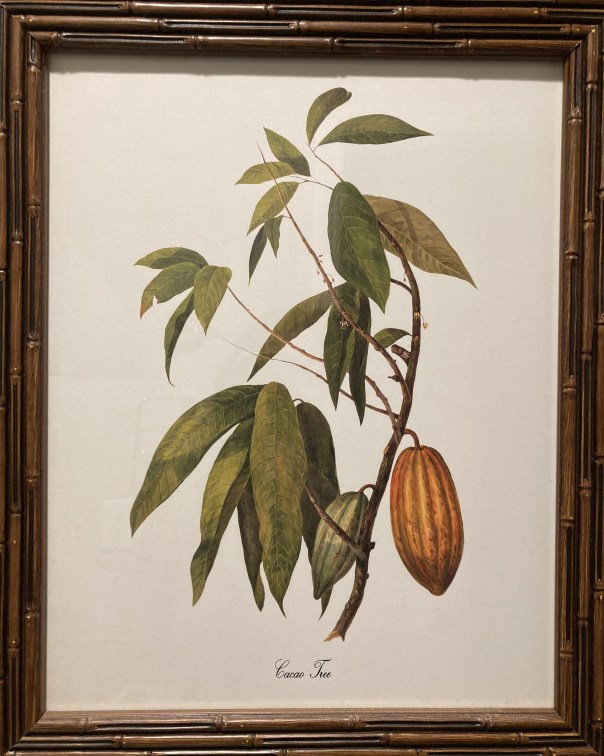
I have it on good authority that this poem/transmission was inspired by viewing cacao pods in Ecuador, reading a book about how chocolate is processed, and bringing space travel into the mix.
What prize will you snag? Claw Machine: The Anthology has officially launched its Kickstarter campaign! This book will feature dark speculative stories themed around—you guessed it—claw machines, including my story “Narrowly, Narrowly Caught.”
I hope you’ll allow yourself to get ensnared in this captivating theme. Please help spread the word.
Some generous soul out there nominated my poem “Bridge of Grass, Bridge of Suspension,” from my mini-chapbook The Inca Weaver’s Tales, for the Rhysling Award!
I’m in good company—there are so many jaw-dropping poems on the nominee list, I encourage you to go read as many of these works as you can find. We won’t all be named finalists, alas, but it’s an honor to be nominated. And please go read others’ poems, too. Maybe you’ll find some new favorites.
This particular poem of mine was a last-minute addition to my mini-chapbook. When Naseem Jamnia was working on the layout, they reached out to see if I had any pieces to fill out a couple extra pages. Provide readers with even more poetry? The answer is always yes! I wrote “Bridge of Grass, Bridge of Suspension” that evening as the bonus poem. I had already done some initial research and brainstorming.
I want to leave you with the final two lines of my poem:
“(Where we have canyons of difference we are in direst need of bridges.)”
When I first started writing poems based on video games five years ago, it felt like such a niche thing. It still does overall, but I’m proud to say I’ve had 3 (!) reprints come out within the past few weeks, in 3 different publications: a couple of anthologies, and a website with a downloadable mini-poster and an audio recording.
I’m excited to have “The Deku Butler’s Son” included in Dangerous to Go Alone! 2, the second volume of gamer poetry from Manawaker Studio.
Just look at this list of contributors. When I was reading through the proof, I couldn’t put it down.
Casey Aimer
Colleen Anderson
Paula Freyja Ardito
Eric Esquivel
Vince Gotera
Robin Rose Graves
J. D. Harlock
Gwendolyn Maia Hicks
Juleigh Howard-Hobson
tom hrycyk
Sarah Jane Justice
Michelle McMillan-Holifield
David McLachlan
Jacob Steven Mohr
C. Payne
Marisca Pichette
Katherine Quevedo
Lynne Sargent
Matthew Scott
Mahaila Smith
Jennifer Elise Wang
Trevor Wright
Next, Meow Meow Pow Powreprinted “Ghosted by Pac-Man” in a downloadable broadside, with cool art by Kim Göransson. I also provided a reading of the poem, a new challenge for me since it’s such a visual poem.
Finally, “Meditations on Super Smash Bros.” is part of Y2K Quarterly: Volume 1, the print annual compiling all 4 issues from last year. This poem of mine is a fun little bit of free verse about the titular game. Or, you know, it might be a rant against authoritarianism. Who knows?
This year’s Worldcon Poet Laureate, Brandon O’Brien, is starting a weekly column about speculative poetry on the Seattle Worldcon blog. For the first post, “Con-Verse: Welcome,” he reached out to members of the Science Fiction and Fantasy Poetry Association (SFPA) for our takes on this expansive type of writing in which anything, truly anything, can happen on the page. I mean that in the sense of both form and content: the speculative genres open up the content to whatever the imagination provides, and poetry as a form allows pretty much any structure to coalesce on the page.
Anyway, Brandon’s blog post is a great way to hear from an array of voices and get a solid foundation on speculative poetry. I based my contribution on some of my previous thoughts from Worldcon 2020. I think Brandon’s column is due out on Mondays, so keep an eye out for more Con-Verse.
I promised a deeper dive into my stats, so let’s get to it. This is going to be a long one, folks. You’ve been warned.
As part of my day job, I work with performance measures intended to help gauge progress toward goals. When it comes to my writing, I sometimes like to appease that analyst side of my brain. Not every writer should necessarily monitor the same things. The key is to identify 1) what matters most to you, 2) what trackable data could help you monitor those specific priorities, and 3) how you can set up your tracking such that you’ll keep your data consistent and up-to-date. It won’t be of much use to you if you aren’t willing to maintain it.
Last year I took a break from my usual strategy SWOT analysis, more out of laziness than anything else. I haven’t decided yet if I’ll do one for this year. I still did plenty of tracking, though. Since I enjoy working with stats, I’ve set up several things I need to update each time I, for example, have a new story or poem published: my website, my submissions and publications tracker, my CV, etc. I get a little dopamine hit from the process, so I try to treat it as a way of drawing out the celebration of a win. (This isn’t the case for everyone, hence my 3 points above.)
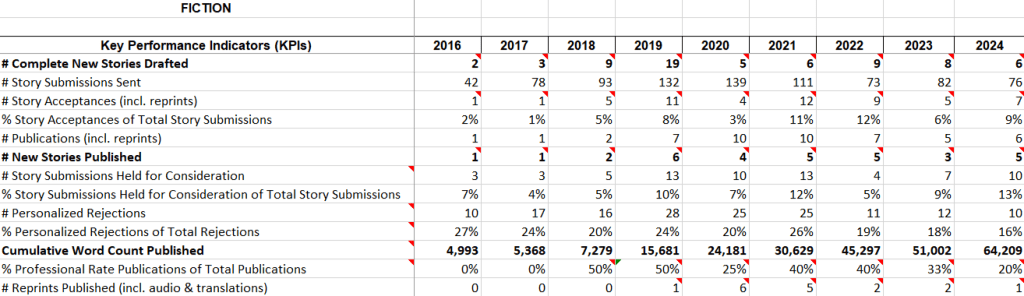
I also update my key performance indicators, or KPIs. I’ve set up that file to span from the year of my first fiction sale, but before I share this latest update, I want to emphasize that my KPIs shared below don’t include the 8 years of submissions and rejections leading up to my first sale. I have all the backup data for those years, but it would make the table longer and show a bunch of zeroes; things really got interesting once I started getting stuff published. But trust me, there were years of sluggish productivity and learning the ropes and getting form rejection after form rejection.I also want to note, these KPIs focus solely on fiction, no poetry or nonfiction. Please bear that in mind. I might change that in the future.
So, how did 2024 stack up for my fiction?
The rows in bold show my highest priorities. I want to generate new work, and I want to get more of it out into the world. Some of the other rows help me focus on the quality of that work; although I’ve noticed my “% Personalized Rejections of Total Rejections” has been trending down, my “% Story Submissions Held for Consideration of Total Story Submissions” has trended up. My “% Story Acceptances of Total Story Submissions” has been a little all over the place; as far as the count of submissions themselves, I’ve been slacking a bit in recent years and should probably make that a focus this year. The “% Professional Rate Publications of Total Publications” metric is a relic from when I was striving to qualify for SFWA membership (I became an associate member in 2020 and a full member in 2022).
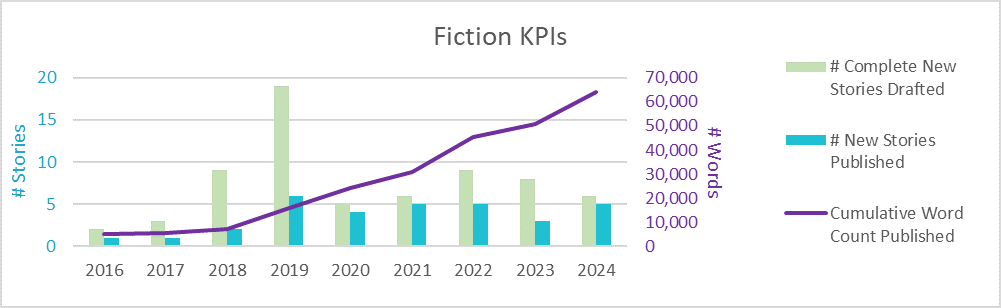
I’m not the flashiest analyst when it comes to data visualization, but I do graph my priority KPIs. I chose bar graphs where I want to compare each year and make sure I’m keeping some healthy pressure on myself, and I used a line graph for the cumulative word count so that I can watch how the slope changes over time and perhaps gauge when I might be ready to pursue a collection. Plus, word count can vary so much, if I used bars for that one they might be too lumpy to show me anything useful.
So, Katherine, what’s up with that green bar?
In 2016 I started grad school, while working full-time, with two young children. Then I finished getting my MBA in 2018, got a windfall of free time back, and had a ton of pent-up creativity start flowing out of me—hence the rising bar. Then 2019, what a year! I had so much momentum coming out of grad school. I’d trained my adult self to make my evenings more productive. Then came 2020…and COVID. My day job got eliminated, I had to do the whole job search thing after quite a few years, and I also started bringing poetry back into my creative life in a big way after having focused on short stories since undergrad. So, the recent years reflect a more equalizing out of my pace. Also, some of my newest story drafts have trended longer than in prior years. Whether it’s flash or a novelette, they each count as one.
That’s just one example of how data can tell a story. And stories can generate data. You get the gist.