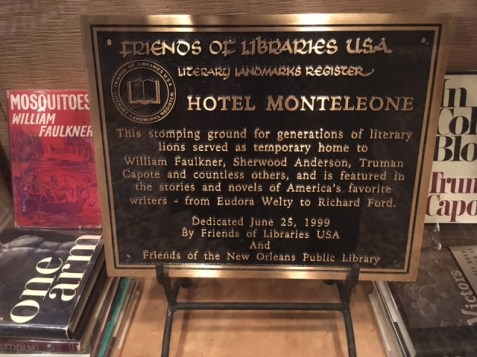
I have arrived in New Orleans, my first time here. A highlight for me was checking out the Hotel Monteleone, whose lobby has a neat display of books by authors who have stayed at the hotel or even mentioned it in their work.
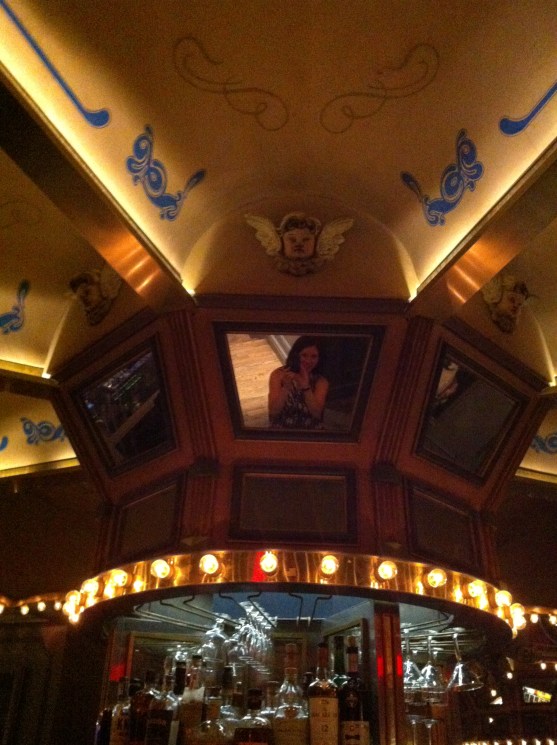
Then my coworker and I lucked into seats at the hotel’s Carousel rotating bar!
I’ve completed a year of grad school, and to say the least it’s been a year of growth. I’ve taken many assessments, from how I deal with conflict to my intercultural competence. I’ve identified core values, crafted a personal mission statement, and undertaken a personal development plan designed to get me outside my comfort zone. I’ve participated in service projects at a local food bank and at a women’s shelter in Chile. I’ve done an interactive simulation of culture clash, honed my presentation skills, and taken on team projects with people I’d just met. And I’ve been getting to know the most fascinating people!
A lot of times I feel like I’m just clinging for dear life to this breadth of experiences, hoping I’ll retain enough later on to reflect back with a depth that my current schedule doesn’t afford.
Also, I think it would be fun someday to use these assessments and other exercises for fictional character development.
I’m still slogging through homework associated with my South America trip and working on a couple of story revisions. In a week I’ll leave for another trip, but first, before I shift gears to that one, here are a few more random photos from my study abroad experience.
We kept moving at a whirlwind pace, pretty much a blur of class stuff and restaurants. For things of note from class, we went to a software company office whose vibe took me right back to my Silicon Valley intern days (disco balls, neon lights on the ceiling, and Ping-Pong and foosball tables). Later on we toured a factory and donned this stylin’ protective footwear:
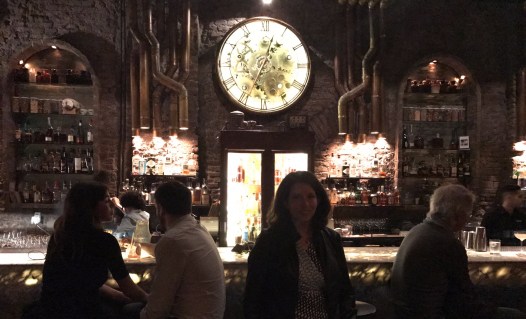
I’ve enjoyed checking out the cool interiors of some of the local restaurants. Highlights include a steampunk bar located through a secret door in a brick wall, and a lounge-type spot with a hanging curtain made of chains! Once I get all my photos and notes in order, I’ll have to do a separate post about all the wonderful food and décor in both Santiago and Buenos Aires, but for now here’s a glimpse of the hidden steampunk bar:
For our last night, we had a tango lesson and then saw a show. I can now say I’ve danced the tango in Buenos Aires, and it was a blast! Then I spent my final afternoon of the trip exploring the city on my own. I made it to El Ateneo Grand Splendid, one of the most beautiful bookstores in the world.
Finally I made it to the Centro Cultural Borges and saw the display about Jorge Luis Borges’ work.
It’s been an amazing trip. Now to enjoy my time back home with my family!
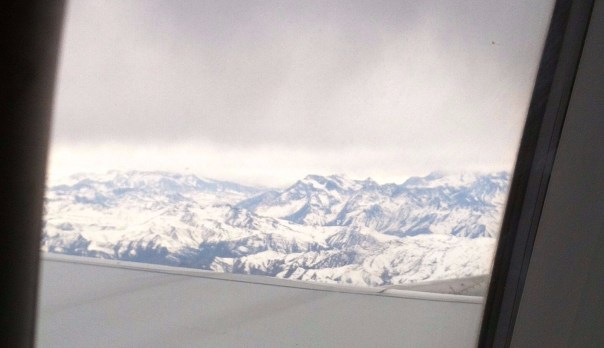
We flew over the Andes very early on Saturday morning, then over the pampas, and into a very foggy Buenos Aires. Here’s the view of the Andes from my plane window:
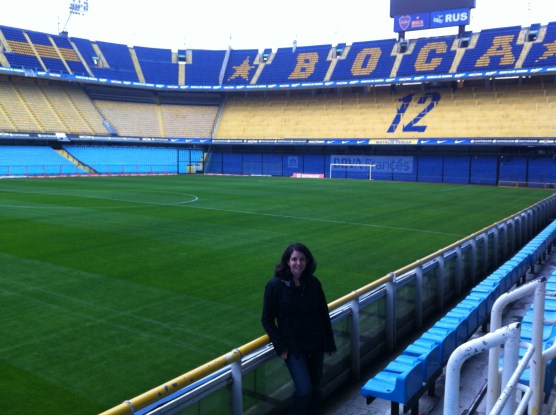
We toured the Boca Juniors soccer stadium and got to step out onto the edge of the field. The next day we attended a match at a different stadium; I particularly enjoyed getting to cheer for the home team with a loud “¡Gooooool!”
I’ve gotten out and about in the city, such as seeing the Casa Rosada, attending Mass at the Catedral Metropolitana where Pope Francis himself used to celebrate the Mass, and enjoying a huge Argentine steak.
We’ve got a lot of company site visits this week for class. It’s been years since I studied abroad in England, and the intensity of this experience reminds me how much room for growth each person possesses within them throughout their lifetime.
We’ve been keeping very busy, so here are some quick highlights:
We ate at a restaurant themed around Chilean poet Pablo Neruda. We visited an innovation center housed on a college campus. We toured a winery in the Casablanca Valley and walked through the amazing, hilly port city of Valparaíso, often compared to San Francisco. Having spent lots of time in San Francisco visiting my maternal grandparents in my youth, I could definitely see the similarities.
Later this morning we fly to Buenos Aires, Argentina! I have really enjoyed my time in Chile.
Things of note since my previous update: This morning we were in our first class when the floor started shaking. We experienced a 4.9 earthquake.
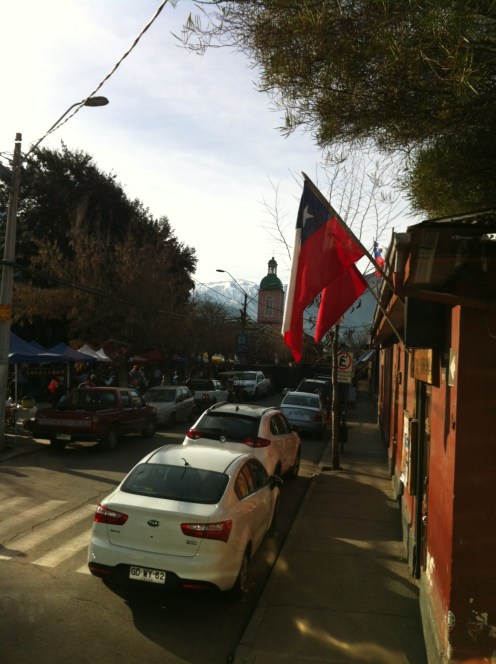
Also, yesterday as we were on our bus heading back from the stunning Maipo Canyon, we were passing through the town of San José de Maipo when our bus encountered a festival. The street we had planned to take was closed, and it was very tight quarters turning, going in reverse, and getting to another road. I would like to apologize to the people of San José de Maipo for the resulting traffic backup! The town was lovely, by the way.
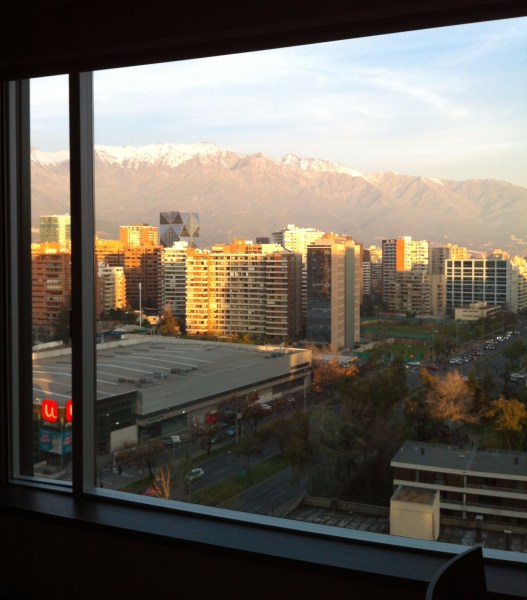
I enjoyed taking in some sights around the city yesterday. It’s awe-inspiring to see a building towering above the others around it, then to look up and see an Andean peak twice that building’s height looming behind it! This is the view from my hotel room:
For me, the highlight while exploring Santiago yesterday was climbing Cerro Santa Lucia. Castillo Hidalgo sits atop it, a fortress with rewards hidden all around for the observant visitor—statues, walkways, fountains.
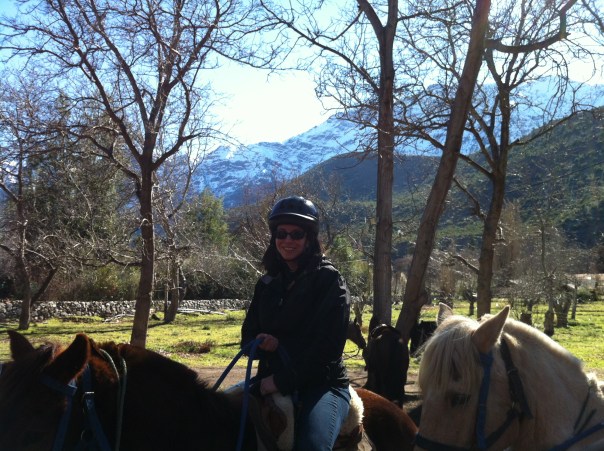
This morning I got to go horseback riding in the Andes. The peaks were stunning. My horse, Pluto, enjoyed munching on grass every chance he got.
For my birthday I got a membership to WorldCon 76 in San Jose, CA, my old stomping grounds from my undergrad days at Santa Clara University! I’m already excited, even though it’s a year away. In the meantime, I’m gearing up for two other trips in the next couple of months, one for grad school and one for work.
First up is a two-week study abroad trip next month that will take me back to South America, but this time I won’t be visiting Ecuador or staying with relatives. Instead I’ll be studying in Chile and Argentina for a week each. I’m packing a journal featuring a quotation by Chilean author Isabel Allende on the cover. I lucked into an opportunity to interview her while I was a student at SCU. She was kind but intimidating, a fascinating person to spend an hour with.
Katherine Quevedo with Isabel Allende in April 2003.
In preparation for my trip, I also read some short fiction by Argentine writer Jorge Luis Borges. I was so blown away by the richness of his speculative fiction, I couldn’t possibly do it justice in this blog post. For now suffice it to say my favorite of his is “The Garden of Forking Paths.”
Nowadays I focus so much on reading my contemporaries, I find it fascinating to occasionally read classics and see what authors used to be able to get away with. In this day and age, everything is expected to be tight, trimmed of adverbs and launching the reader right into the action, but Borges and so many others were free to explore a slow boil, slathering on the details and sometimes meandering toward an anticlimax. (Wow, sorry for those mixed metaphors.) What can one say? Expectations of editors and readers evolve.
As my trip draws near, I’m very grateful for this opportunity to travel and learn. (I will admit, though, the timing is unfortunate because I’ll be missing the total solar eclipse visible from Oregon.)
I’m so excited to share that Triangulation: Appetites is out! This new anthology includes my science fiction flash story “Little Seed,” along with a whole assortment of speculative fiction delicacies for your enjoyment.
This was some very welcome good news for me during a month when I’ve been in dire need of good news. I’ve recently taken on some extra responsibilities at work (currently with no backfill), I’m in the thick of summer term for grad school, and a very, very dear family member was just diagnosed with a major medical issue.
Yet somehow ideas for writing keep bubbling up. I didn’t used to think I wrote to escape, but now I’m less certain.








 is out! This new anthology includes my science fiction flash story “Little Seed,” along with a whole assortment of speculative fiction delicacies for your enjoyment.