Poetry pie charts for the curious and data-minded

I was going to do this later this month, but I got on a roll…  My younger son came into my office earlier this evening, asked if I was writing, then spotted my screen and asked, “Is that a pie chart?” 

“Oh,” I responded with glee, “it’s not just one pie chart.”  I mean it when I say in my bio that I enjoy making spreadsheets.  It’s a day off from my analyst job, and I chose to spend part of it crunching the numbers on my poetry data (you may recall, I do this regularly for my fiction). 

Was this poetry analysis worth it?  What might we glean from this endeavor?  (This is another long one, folks.) 

For some context, I started regularly submitting poetry in earnest in 2018, but I technically have some earlier submissions.  I decided to summarize my cumulative numbers, totaling all the years together to look at how the grand totals are distributed across various categories. 
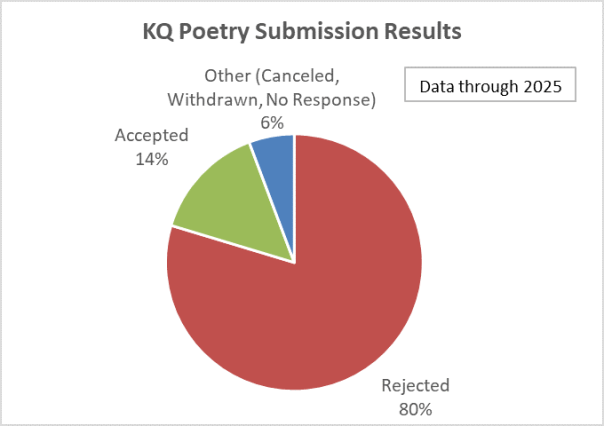
This represents over 700 poem submissions over 17 years (with the bulk from 2018 onward).  Some submissions consisted of a batch of poems, but I treat each poem individually, as some markets might take one, some, or all in a batch.  It takes a lot of submitting and getting rejected, a lot of putting yourself out there, to have a chance at the successes. 

In recent years I attempted an experiment with my poetry submission strategies, but I’m sorry to report that it didn’t result in much in the way of insights.  Part of that might have to do with the fact that I lost some traction toward the end of it, and I think a lot of it is that my submissions aren’t necessarily consistent from one year to the next, so it’s hard to extrapolate the effects.  But for the record, here’s what I tried: 

  • Prior to 2024, I submitted only to markets with free submissions, and I tried to prioritize markets that also pay contributors. 
  • In 2024, I submitted only to markets that not only have free submissions but also pay contributors, with very few exceptions. 
  • In 2025, I experimented with submitting to places that charge a submission fee, within reason.  I lost traction on that throughout the year.

Now let’s look at the financial side of things.  Yes, this is my art.  I value having an unrelated day job because it means I can write whatever the heck I want.  However, I also have a business background and believe that poets should embrace the duality of being artists and business people to help our lovely art “live its best life” out there. 
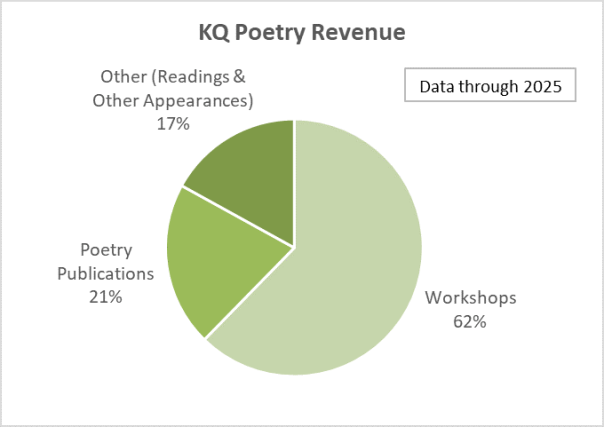
I remember hearing an established poet say that, when it comes to getting paid for their art, they hope their poetry can buy them a nice lunch. 

I’ve long suspected, and now I have the numbers to back it up, that many people would rather pay a poet to teach them how to write poetry than they would pay for that poet’s poetry.  In other words, I can pour my heart and soul and energy into creating a poem, or I can spend some time planning a workshop and earn waaay more.  I am not in this to pay the bills, so oftentimes the compulsion to create new art takes precedent despite the perceived ROI.  I’m not against workshops, by the way!  I particularly enjoy introducing fiction writers to poetry, and non-spec poets to the speculative genres.  Expanding people’s interest in and comfort with poetry is crucial.  It’s how we build the readership and expand opportunities. 
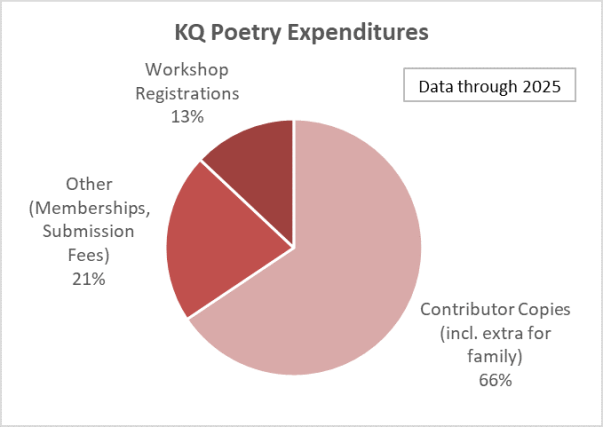
When my work appears in a book, I choose to purchase extra copies, including for family members.  It’s interesting to see just how much that takes up of my direct investment into the poetry side of my writing career.  Markets that don’t charge submission fees and that pay their contributors are wonderful, and those that also don’t involve purchasing contributor copies are few and far between. 

Finally, I opted to look at what types of poetic structures I’ve had published. 
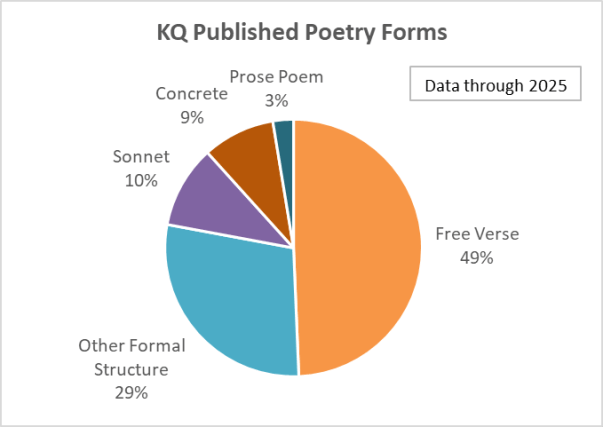
I’ll be honest, as dominant as free verse is nowadays, I was surprised to see how many of my own poetry publications fall into that category.  For anyone curious about the other forms, that includes things like triolet, pantoum, abecedarian, sestina, blank verse, heroic couplets, etc. 

All that to say, it’s a lot of effort to get one’s poetry into the world, hoping to connect with readers who will appreciate it.  The economics don’t reflect the intangibles, all the inputs that go into this type of genuine human creativity and the ultimate value of it.  But we do it anyway.  And as much as I enjoy a good spreadsheet, I much prefer the toil of getting a new publication and knowing exactly how much of my heart went into earning that new data point. 
An atypical 2025 recap post

2025 was a big year for me.  Many of you were along for the ride, so rather than rehash my own stuff, I’d rather highlight inspiring things that some of my friends and colleagues accomplished last year!  

  • Elizabeth Beechwood released her nonfiction book, How to Write Animal Characters.  She’s spent years researching this topic, for the scientific history and recent developments as well as gathering examples of these types of characters in literature.  This is your new go-to resource for crafting compelling animals on the page. 
  • Maggie Slater released some zines that combine her word prowess with her visual art.  So cool!  That’s in addition to her fiction publications, including a Pushcart nom.  She also started up an honest-to-goodness snail mail newsletter, and it’s pretty much the highlight of my day to receive one of these in the mail. 
  • Kirk Glaser, one of my professors at Santa Clara University, had a poetry collection published called The House that Fire Built, which tells a full narrative arc.  It isn’t speculative, it isn’t even fictional.  It’s about his family’s experience with a house fire, and let me tell you, there were scenes that had me on the edge of my seat, all told through lovely, challenging verse. 

I’ll be back soon with some metrics.  Last year I did a deep dive into my fiction data, so perhaps this time I’ll focus on the poetry side. 

“El Grotesco” and “The Poison Dart Frog Prince” published in SpecPoVerse

Early Happy New Year!  Today, I have two poems out in volume 1, issue 3 of SpecPoVerse, “El Grotesco” and “The Poison Dart Frog Prince.” 

For “El Grotesco,” I created a Latin American kaiju.  I wrote this poem almost two years ago, in January 2024, after seeing Ecuador in the news.  My father’s birth country is such a beautiful, beautiful nation plagued in recent years by rising crime and violence. After I found out their government had declared a state of internal armed conflict, and as I read about the impacts to the people caught in the middle, this poem emerged fast. 

For “The Poison Dart Frog Prince,” I wrote a draft right before some of my digital files got corrupted and lost.  This was one of them.  I wallowed in frustration at having lost my new poem… then I pulled myself together and decided to write it again, from scratch, better than before.  I had just attended a talk by Gabriela Denise Frank where she shared some of her concrete poems, such as in the shape of a crab or fish.  That inspired me to write the new version in the shape of a frog, rather than the typical lineated free verse of the missing version.  I’m much happier with this new one. 

“Song of the Balsa Wood Bird” in a college textbook

Look at this beauty I received in the mail this week: 

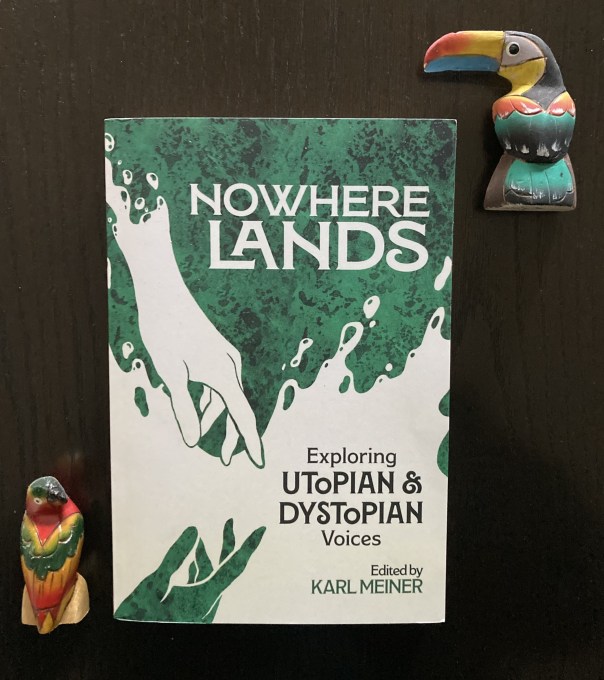
Cover of textbook Nowhere Lands: Exploring Utopian & Dystopian Voices, with green and white hands reaching toward each other. The book is surrounded by two balsa wood bird figurines, one a toucan and one a parrot.

Nowhere Lands: Exploring Utopian & Dystopian Voices is a new college textbook from Chemeketa Press, and it includes my story “Song of the Balsa Wood Bird.”  This story was first published in Fireside Magazine and reprinted in Best of Utopian Speculative Fiction.  I’m honored that it continues to resonate, and being part of the table of contents in Nowhere Lands floors me.  I’m next to Mary Shelley!  And in the same book as Ursula K. Le Guin’s “The Ones Who Walk Away from Omelas,” one of my all-time favorite short stories! 

On the topic of utopia/dystopia, I wanted to share some comments that I heard another writer, Chinelo Onwualu, say on a panel a few years ago that stuck with me:  

“Even the most dystopian fiction implies ‘There but for the grace of God,’ or ‘There if we’re not careful.’” —Chinelo Onwualu

“When you are already living in a dystopia, the act of writing a utopia is itself revolutionary.” —Chinelo Onwualu

Powerful stuff.

Muddy Goose wrap-up, and a glimpse ahead

The Muddy Goose Guide to the Weird Northwest anthology on a table next to a plush goose.

Had a great time at the Muddy Goose anthology reading at BOLD Coffee & Books last night!  A treat for me was getting to read part of a scene from “The Queen of All Roses” that takes place in the Goose Hollow section of Portland where we were, within view of the light rail station I mention in my story.  On top of that, Cyrus Amelia Fisher, the author who read right before me, was wearing a sweater with carnivorous plants on it—my story features carnivorous plants!

Looking ahead, I’ve had a recent batch of acceptances mixed in amongst the usual dose of rejections.  First, my story “Gearheart” will be part of the anthology Clocks from Little Key Press.  Second, my story “The Sauce Packet King of the West Hills” will be reprinted in Small Wonders. Third, I’ll have a poem called “Avenue of the Peaceful Giants” in The Ranger’s Almanac.  Those are all due out next year. 

And fourth, squeaking in at the tail end of this year, I’ll have two new poems in SpecPoVerse.  Look for “The Poison Dart Frog Prince” and “El Grotesco” coming very soon.  I’ll pop in with news on those probably right around New Year’s. 

In the meantime, happy holidays, everyone!  Take care of yourself and each other. 

Two reprints today: a ghost story and a decadent ode

Drawing of a ghost with a green bow reading a green book under a raincloud. Text: Scary Stories Whispered in the Rain presents "Discount Night at the Haunted Eco Lodge" by Katherine Quevedo

You can hear my eco-horror story “Discount Night at the Haunted Eco Lodge,” set in the Ecuadorian rainforest, on the podcast Scary Stories Whispered in the Rain.  When I came up with this title, it cracked me up, and I knew I had to bring it into being somehow.  Conjure it, you might say.  This is one of the writing projects I worked on during the worst of the COVID lockdowns.  Escapism at its finest, even if it meant the research involved picking up library books at a curbside table while fully masked, dreaming of faraway places while mostly trapped at home.  The story first appeared in the anthology Triangulation: Habitats, and it’s fun for me to hear it now read aloud. 

In poetry news, my “Ode on Keats’s ‘Ode on Indolence’” has been reprinted in The Hyacinth Review.  It first appeared in The Decadent Review.  I have to be honest about this one, I wrote it as an undergrad.  I had an assignment to write an essay about an ode, and I figured that the best way to show that I understood odes would be to try writing one.  This poem was the result (I’m happy to report that I got an A on the assignment and the professor read the poem to the class).  It took me years to work up the courage to send it out.  Don’t self-reject, my friends! 

Stories getting read aloud – Muddy Goose and more

I’ve got an update on the in-person reading for The Muddy Goose—but first, here’s the link to our video event from earlier this week, in case you’re unable to join us in Portland. 

Now, if you want to meet some of the contributors, we’ll be at BOLD Coffee & Books on Friday, Dec. 19 at 7pm. 

Graphic with the cover of the anthology The Muddy Goose Guide to the Weird Northwest, photos of editors Erik Grove and Frances Lu-Pai Ippolito, and live reading day/time at BOLD Coffee & Books: Dec. 19 (2025), 7pm.

One more piece of news, my story “Discount Night at the Haunted Eco Lodge” (originally from Triangulation: Habitats) has been reprinted in the Scary Stories Whispered in the Rain podcast.  Currently the episode is only available on their Patreon (go check it out if you’d like to support the podcast).  I’ll post again when it becomes available to the public. 

Muddy Goose anthology live events (online and in-person)

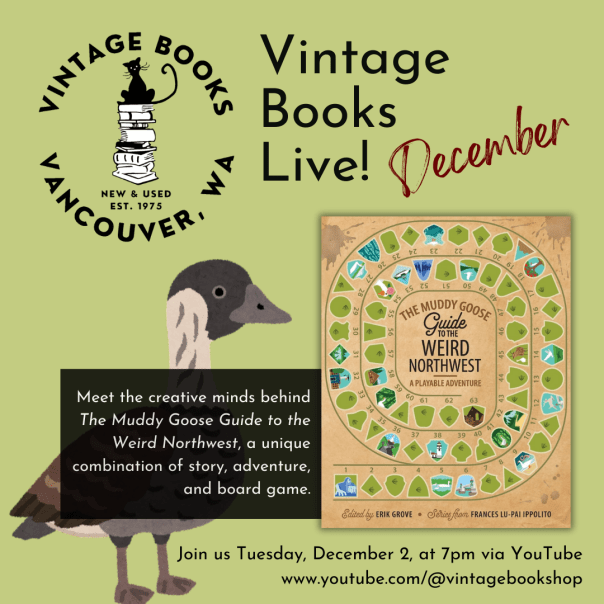
One more reminder that I’ll be hanging out online with other contributors to The Muddy Goose Guide to the Weird Northwest anthology tomorrow evening, hosted by Vintage Books Live!  This isn’t quite a reading…  We’ll find out together what topics get explored and what tangents get traversed. 

Graphic for an online event hosted by Vintage Books Live! on Dec. 2, 2025 with contributors to The Muddy Goose Guide to the Weird Northwest anthology.

And for those in the Portland area, we’ll have a fun in-person event later this month.  Announcement coming soon. 

Pushcart Prize nomination for “Narrowly, Narrowly Caught”

I got word that my story from the Claw Machine anthology, “Narrowly, Narrowly Caught,” has been nominated for the Pushcart Prize!  This is my story in which a high school reunion and memories of grad night collide, and a claw machine reveals more than seems possible.  I leaned into my economics background and my interest in arcades for this one.  It’s the closest I’ve come to one of my stories having an actual soundtrack. 

It’s also a story in which I challenged myself to make the act of prepping a salad as tense and meaningful as I could, as evidenced here (yes, that is my actual, deplorable handwriting): 

Handwritten notes for a scene from "Narrowly, Narrowly Caught" by Katherine Quevedo
I seriously have 3 pages of notes like this about the salad scene.

Needless to say, I’m honored that the editor selected my story! 

“The Queen of All Roses” published in The Muddy Goose Guide to the Weird Northwest

My newest story, “The Queen of All Roses,” is part of The Muddy Goose Guide to the Weird Northwest: A Playable Adventure anthology from Demagogue Press.  The front cover has a playable version of the Game of the Goose, and the stories and poems have characters embarking on dark journeys involving real landmarks in Oregon and Washington.  Technically, this book had a special pre-release edition earlier this year at Worldcon, but it’s officially available today. 

So, what did I write about?  I may have created a cryptid… 

“The Queen of All Roses” took inspiration from my late nights commuting home from grad school on the MAX light rail train, plus input from my California nieces and nephew on arriving in Portland’s recently updated airport, and how I grew up visiting the International Rose Test Garden in Portland’s Washington Park. 

In fact, my younger son joined me on a research trek to the rose garden for this story.  We got an appropriately eerie day, with lots of fog. 

View of trees and fog at Portland International Test Rose Garden

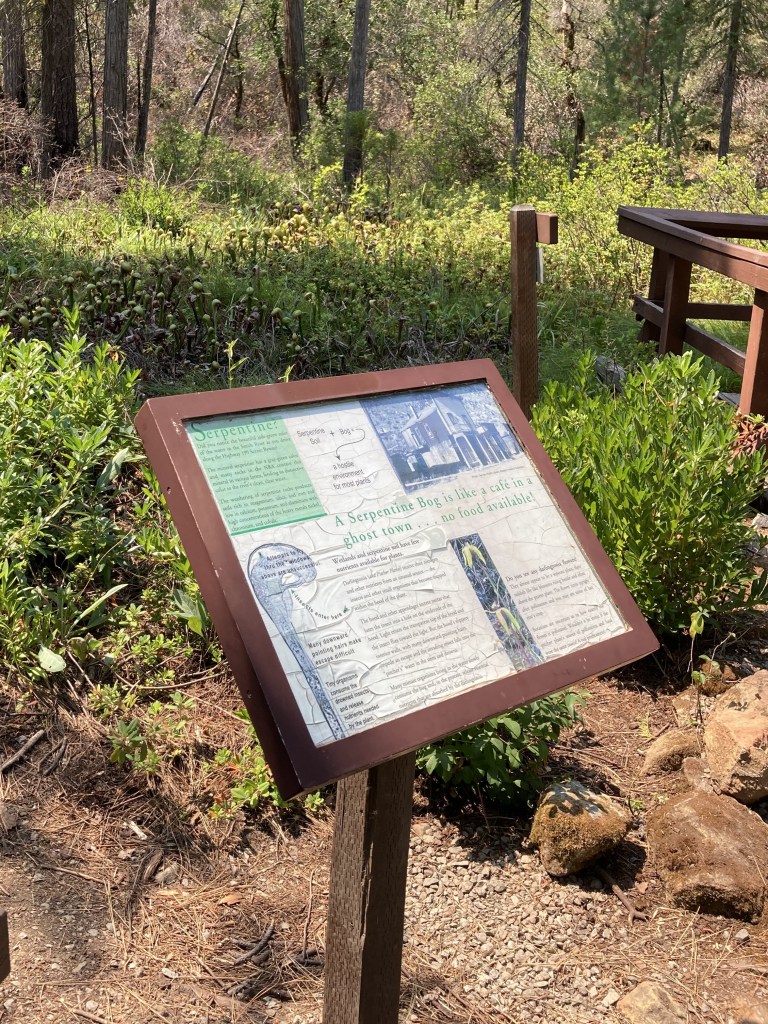
I also drew upon a stop our family made during our road trip to the Bay Area last year.  We checked out the Darlingtonia Trail to see a bog of pitcher plants. 

If you want to know how I meshed all that in under 3,500 words, you’ll just have to read it!