Category Archives: Uncategorized

Christmas gifts from my subconscious, plus a steampunk high tea

As my break has drawn to a close, I’m happy to report that my subconscious gifted me a couple of plots and some important characterization for two story drafts that were little more than scribbles last summer.  Progress!  These things must have been brewing in me while my writing was on hold.

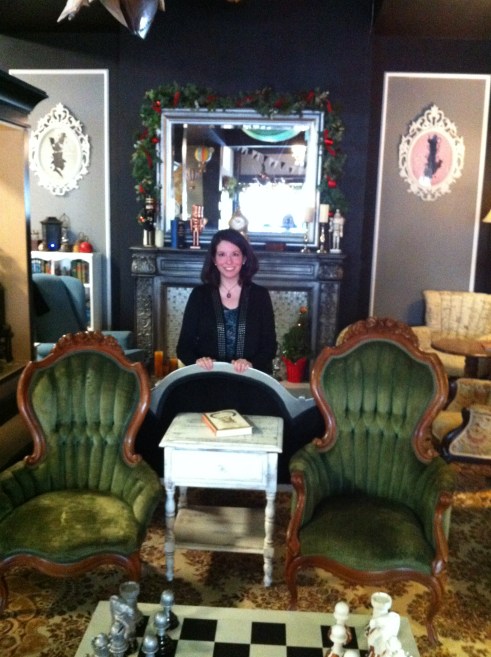
Speaking of brewing, I finally got a chance to check out a new Victorian steampunk teahouse located right here in Beaverton, called Clockwork Rose Tea Emporium.  They held a Charles Dickens themed high tea for the holidays, and although I don’t drink tea, my mom and sister thoroughly enjoyed all three of our flavors.  (And I must say they make a mean pot of hot chocolate!)  The décor was lovely, especially with holiday touches like Nutcrackers and multiple copies of A Christmas Carol laid out around the fireplace.  I particularly enjoyed the sign warning visitors of airship pirates.

katherine-quevedo-at-clockwork-rose-tea-emporium

Writerly holiday décor

If you live in the Portland area, be sure to visit the Pittock Mansion this holiday season!  One of my sisters helps to decorate one of the rooms of this historic property each year (with much support from our mom, too).  A few years ago she and her friend decorated the writing room, and as the overall theme for the mansion was “A Locally Crafted Christmas,” they focused on Oregon authors in their room.  I made sure my local heroes were represented, including Ursula Le Guin, Jay Lake, and others.

Here are some photos of the 2013 decorations:

In-person research for fictional settings

So where has Katherine been these days?  Busy with work, writing, and enjoying family time in preparation for … grad school!  In keeping with my academic goals over the next couple of years, you may see a decidedly research-focused bent to my blog posts. 

We fantasy and science fiction writers draw on much of the real world in our work.  I have always loved the idea of using direct experiences as research for my writing.  I’ve taken classes in everything from knife fighting and archery to foraging and wilderness survival.  But it’s taken me a pathetic amount of time to realize that, just because I can’t take these types of classes on a regular basis, and just because I don’t live in a part of the world where I can tour a castle at the drop of a hat, it doesn’t mean I can’t document experiences in my life on a regular basis to better inform my speculative fiction. 

Namely, I’ve been decent in the past at jotting notes about my surroundings during big vacation trips, but now I’m trying to apply that same principle to more local happenings.  Work seminars, behind-the-scenes site tours, social events – these are all ripe settings for capturing on the page.  I’m trying to focus on the locations that pop up as part of my weekly routine but that take me a little outside of it.  Procrastination is not your friend in this.  Memories erode over time, so discipline and timeliness are your friends. 

As I write my notes, I focus on multiple sensations—obviously the visuals, but also the sounds and smells, the textures and temperatures, and perhaps most importantly the impressions that the place made on me.  Maybe it called to mind a metaphor that will help me convey that setting to the reader in few words.  Or perhaps it evoked a mood that I wish to replicate through my own choice details.  Was the place creepy?  Breathtaking?  If I was there while it was mostly empty, can I imagine it crowded?  If I was there in daylight, would it be illuminated at nighttime, or dark? 

The beauty of this research approach, besides just the richness of details available, is that experiences that might otherwise feel mundane or that might be soon forgotten instead become opportunities to be memorialized in a story.  They enable a character to have a life-changing adventure in a similar place, in a way that feels real to the reader.  Also, you never know when your research may alter the plot.  Perhaps reading a particular note someday will inspire a crucial moment, such a prop that a character will be able to grab and use, or something that evokes a flashback and enables the reader to garner key information in a new way. 

So if you’re a writer, the next time you feel “dragged to” an event, look at it as research.  Hey, even if the location itself ends up being unusable for your purposes, maybe you’ll be exposed to a character idea, a compelling snippet of dialogue, or a new interpersonal dynamic to explore.  Just don’t shirk the important, time-sensitive step of recording the details so you can someday pass them on to the reader! 

Returning to the imagination of youth

When I get home from work, I can’t wait to see what games my preschooler and toddler have come up with.  More and more as I see their imaginations developing, I find myself pining for that unbridled creativity of youth, the kind that knows no critics, expectations, or cynicism.

Then I try to remind myself that experience has afforded me a deepening well from which to draw for my craft, complete with many forms of love, heartache, terror that has lasted weeks, the thrill of experiencing new parts of the world (with a profound appreciation for my place in it), and the privilege of being able reflect back on things with ever-maturing emotions.

It’s an expected tradeoff, I suppose.  But still, I wonder what sorts of worlds I could create if I could just couple the vividness of my imagination from before it learned self-consciousness with the writing skills and wisdom I’ve been honing in adulthood.  To do that in a way readers can enjoy and participate in is my ultimate writing goal, now that I think about it.

Traveling through time and space (or at least down the block)

Have you ever stopped to consider how much of speculative fiction revolves around travel?  It may be backward or forward through time, or it may be across realms as part of a quest, but either way, a character’s emotional journey often matches up with—or at least stems from—a literal journey.

This connection makes sense, since in real life a change in our surroundings forces a change in our perspective as well, however small or subtle.  It opens up the possibility of something out of the ordinary happening.  And, if it’s a big enough journey, it puts our senses and long-term memory into overdrive.  Such is the stuff of compelling fiction as well.

A writer has different options to get a character from point A to point B, whether the movement happens geographically, temporally, or both.  You can show the character’s progress in detail, summarize it, or use a scene break to imply it.  Like so many perilous journeys, of course, each of these approaches has its own pitfalls to beware.

Beginning writers sometimes get so caught up in trying to show rather than tell that they rely too heavily on the detailed approach.   The result can be burdensome to the reader.  If you were telling a friend about a job interview you had, would they really need to hear about your commute there if nothing significant happened on the way?  Now, it’s one thing if you ran into a traffic jam and were late, or got lost and stumbled onto a portal to another world or something like that, but otherwise wouldn’t you just cut straight to the interview itself?

On the other hand, summarizing a character’s passage through time or space keeps both the character and the pace moving.  However, now you run the risk of glossing over something that would have made a compelling scene or snippet of dialogue, so proceed with caution in, ahem, abridging your character’s progress (whether over a bridge or not).

Sometimes you just need to skip ahead to the destination via a scene break.  The challenge here is how to clue the reader in to where and when the new scene or chapter is taking place.  Sometimes it works just fine to spell it out (“Ten years later …”).  Other times a simple character action is enough, the same way you would introduce the setting at the beginning of a story.  Either way, the point is to keep the reader involved in the flow of the story and not make them pause in confusion about a sudden change in surroundings.

As a writer learns to skillfully navigate these navigations, the reader can sit back and enjoy a story that moves at a decent clip without losing them in the process.  We speculative fiction writers provide the ultimate travel experience, unfettered by the limitations of the known world, with no packing required.  Even if you’re just taking a character down the block, you can imbue the experience with tension, significance, and resonance.

Isn’t it amazing how a writer’s choice sequence of words can leave the reader utterly, shall we say, transported?

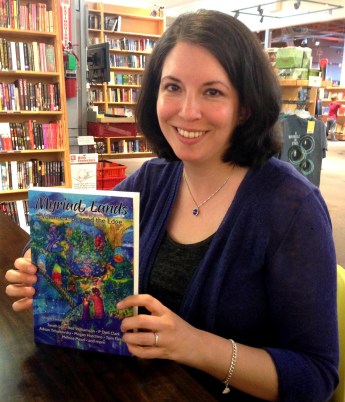
If you like your fiction to take you to worlds beyond ours, don’t miss Myriad Lands: Volume 2: Beyond the Edge.

Katherine Quevedo with Myriad Lands Vol. 2

Publication announcement: “Venom in the Cloud Forest”

Check out my fantasy story “Venom in the Cloud Forest,” available now in Myriad Lands: Volume 2: Beyond the Edge!  This anthology from Guardbridge Books features stories of non-Western fantasy (also don’t miss Myriad Lands: Volume 1: Around the World).

Inspired by my father’s native country of Ecuador, “Venom in the Cloud Forest” takes place in a high-altitude rain forest and features fever dreams, petroglyphs, and a dash of magic.  I couldn’t be prouder that my first contribution to fantasy literature involves that side of my culture and is part of the Myriad Lands experience!

My first taste of the writerly life

I remember the point in my life when I started taking myself seriously as a writer.  Back when I was in high school, I was in a Barnes & Noble bookstore with my mom one afternoon when I spotted a poster advertising a writing contest for young writers.  Poetry was allowed, so I dusted off one of my least angsty-teenager poems and sent it off.  And I actually won!

As the recipient of the first ever Willamette Writers Young Writer Award (currently known as the Students Grades 9-12 category of the Kay Snow Writing Awards), I attended the annual Willamette Writers Conference for free.  My parents dropped me off at the hotel near the Portland Airport, and I approached the registration table timidly, all too aware of the fact that I was by far the youngest person present.

But soon enough I felt right at home.  I got my own name badge!  And a folder where I could collect all manner of workshop handouts!  I chatted with a woman who was writing a book about androids.  And a college student (the attendee closest to me in age that I saw) recommended that I read Fahrenheit 451.  I learned about character development and endings.  Author Steve Perry, from my hometown of Beaverton, cracked me up with the anecdotes he told in his workshop about speculative fiction.  I participated in writing exercises and felt the rush of inspiration under pressure.

I was a writer.

I still have that folder and the handouts.  I can see where I had scrawled Fahrenheit 451 on a corner of the conference program.  Yes, I think I even still have my name badge.  Attending that event was a milestone for me because it marked the first time I realized what a vast community of writers there was out there and how natural it felt for me to be among them.  These were my people.  They were curious and observant, encouraging and passionate.  Mr. Perry’s workshop in particular struck me because it was where I first got the idea to focus on speculative fiction.  I had always loved reading those subgenres, it just hadn’t occurred to me until then to take them on myself and devote my creativity to them.

Of course, there is no writerly life without the writing; attending conferences and workshops feeds part of the soul, but it is not the same as regularly committing words to the page and creating new worlds to be shared.  But I remain convinced that I would not be the writer I am today had I not been lucky enough to attend that conference.  It was a jolt, and quite frankly I still get a little giddy whenever I attend a writing event (such as Westercon, which I will be attending next weekend!).  And all from one little poem, and a serendipitous trip to a bookstore.

Some things never change (and some do)

This blog has been a long time in the making.  It seems a fitting venue for me to share my enthusiasm for writing.  I loved crafting stories from an early age and have dedicated much of my adulthood to studying the art form and trying to refine my own contributions.

A few years back, my parents gave me a plastic storage tub full of my old papers.  A good portion of these were little books I had cobbled together as a young girl.  Many were on scratch paper cut into quarters and stapled together, or glue-bound notepads that I’d turned sideways to look like typical book binding.  A couple were on paper napkins.  A few are from when I was so young, my mom’s handwriting appears under my rudimentary drawings, capturing what I had narrated to her because I literally hadn’t learned to write yet.

One of my personal favorites is from second grade.  I wrote it on 3-hole-punched paper, bound it with green yarn, and added an About the Author section in the back.  Included in this section was a cutout of my school portrait and a bio in which I described my eye color using the name of a Crayola crayon and bemoaned the fact that I didn’t have any pets. Check it out:

IMG_5944

Fast forward to adulthood, where my passion for telling stories in the written word continues.  I’ve got (lots of) rejection letters and (a couple) acceptance letters to prove it.  I’ve been working at this for years and years, and thus far I have a handful of publications to my name, including my first sale, a short story called “Venom in the Cloud Forest,” appearing in the Myriad Lands Volume 2 anthology from Guardbridge Books next month!

And although my eyes are the same color they were when I was seven, I now call them by the more generic and less confusing term “brown.”  Incidentally, though, I still don’t have any pets.