I was going to do this later this month, but I got on a roll… My younger son came into my office earlier this evening, asked if I was writing, then spotted my screen and asked, “Is that a pie chart?”
“Oh,” I responded with glee, “it’s not just one pie chart.” I mean it when I say in my bio that I enjoy making spreadsheets. It’s a day off from my analyst job, and I chose to spend part of it crunching the numbers on my poetry data (you may recall, I do this regularly for my fiction).
Was this poetry analysis worth it? What might we glean from this endeavor? (This is another long one, folks.)
For some context, I started regularly submitting poetry in earnest in 2018, but I technically have some earlier submissions. I decided to summarize my cumulative numbers, totaling all the years together to look at how the grand totals are distributed across various categories.
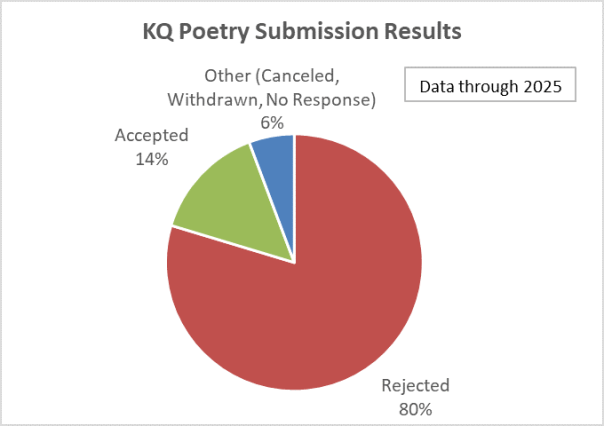
This represents over 700 poem submissions over 17 years (with the bulk from 2018 onward). Some submissions consisted of a batch of poems, but I treat each poem individually, as some markets might take one, some, or all in a batch. It takes a lot of submitting and getting rejected, a lot of putting yourself out there, to have a chance at the successes.
In recent years I attempted an experiment with my poetry submission strategies, but I’m sorry to report that it didn’t result in much in the way of insights. Part of that might have to do with the fact that I lost some traction toward the end of it, and I think a lot of it is that my submissions aren’t necessarily consistent from one year to the next, so it’s hard to extrapolate the effects. But for the record, here’s what I tried:
- Prior to 2024, I submitted only to markets with free submissions, and I tried to prioritize markets that also pay contributors.
- In 2024, I submitted only to markets that not only have free submissions but also pay contributors, with very few exceptions.
- In 2025, I experimented with submitting to places that charge a submission fee, within reason. I lost traction on that throughout the year.
Now let’s look at the financial side of things. Yes, this is my art. I value having an unrelated day job because it means I can write whatever the heck I want. However, I also have a business background and believe that poets should embrace the duality of being artists and business people to help our lovely art “live its best life” out there.
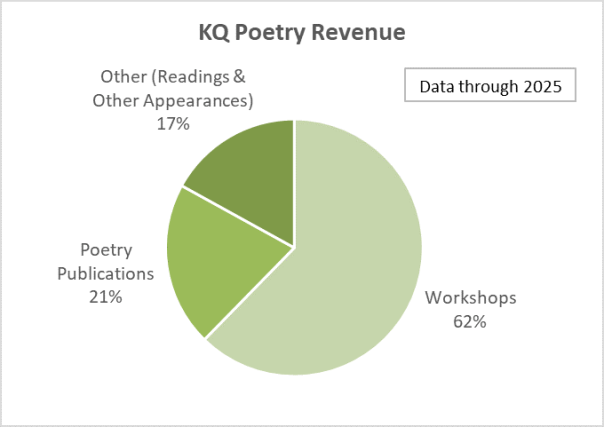
I remember hearing an established poet say that, when it comes to getting paid for their art, they hope their poetry can buy them a nice lunch.
I’ve long suspected, and now I have the numbers to back it up, that many people would rather pay a poet to teach them how to write poetry than they would pay for that poet’s poetry. In other words, I can pour my heart and soul and energy into creating a poem, or I can spend some time planning a workshop and earn waaay more. I am not in this to pay the bills, so oftentimes the compulsion to create new art takes precedent despite the perceived ROI. I’m not against workshops, by the way! I particularly enjoy introducing fiction writers to poetry, and non-spec poets to the speculative genres. Expanding people’s interest in and comfort with poetry is crucial. It’s how we build the readership and expand opportunities.
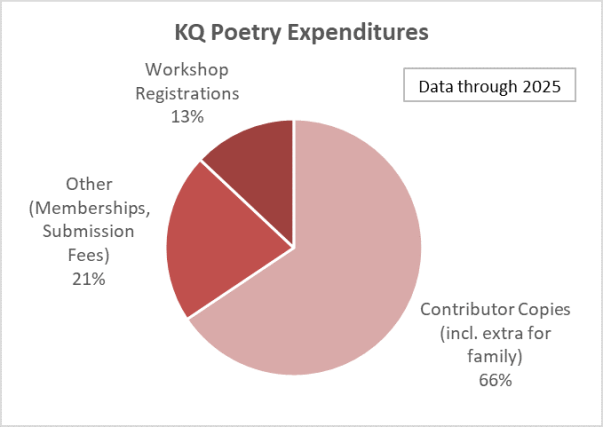
When my work appears in a book, I choose to purchase extra copies, including for family members. It’s interesting to see just how much that takes up of my direct investment into the poetry side of my writing career. Markets that don’t charge submission fees and that pay their contributors are wonderful, and those that also don’t involve purchasing contributor copies are few and far between.
Finally, I opted to look at what types of poetic structures I’ve had published.
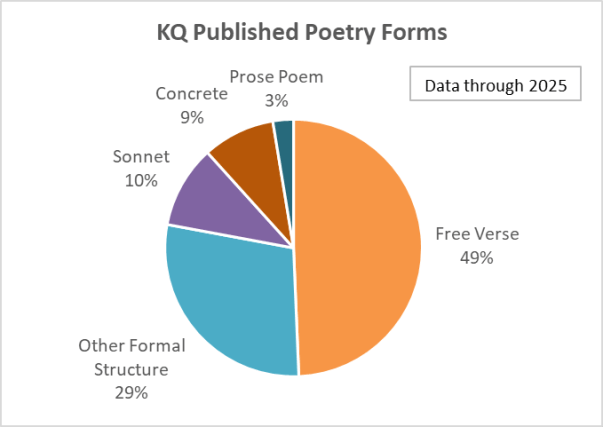
I’ll be honest, as dominant as free verse is nowadays, I was surprised to see how many of my own poetry publications fall into that category. For anyone curious about the other forms, that includes things like triolet, pantoum, abecedarian, sestina, blank verse, heroic couplets, etc.
All that to say, it’s a lot of effort to get one’s poetry into the world, hoping to connect with readers who will appreciate it. The economics don’t reflect the intangibles, all the inputs that go into this type of genuine human creativity and the ultimate value of it. But we do it anyway. And as much as I enjoy a good spreadsheet, I much prefer the toil of getting a new publication and knowing exactly how much of my heart went into earning that new data point.
